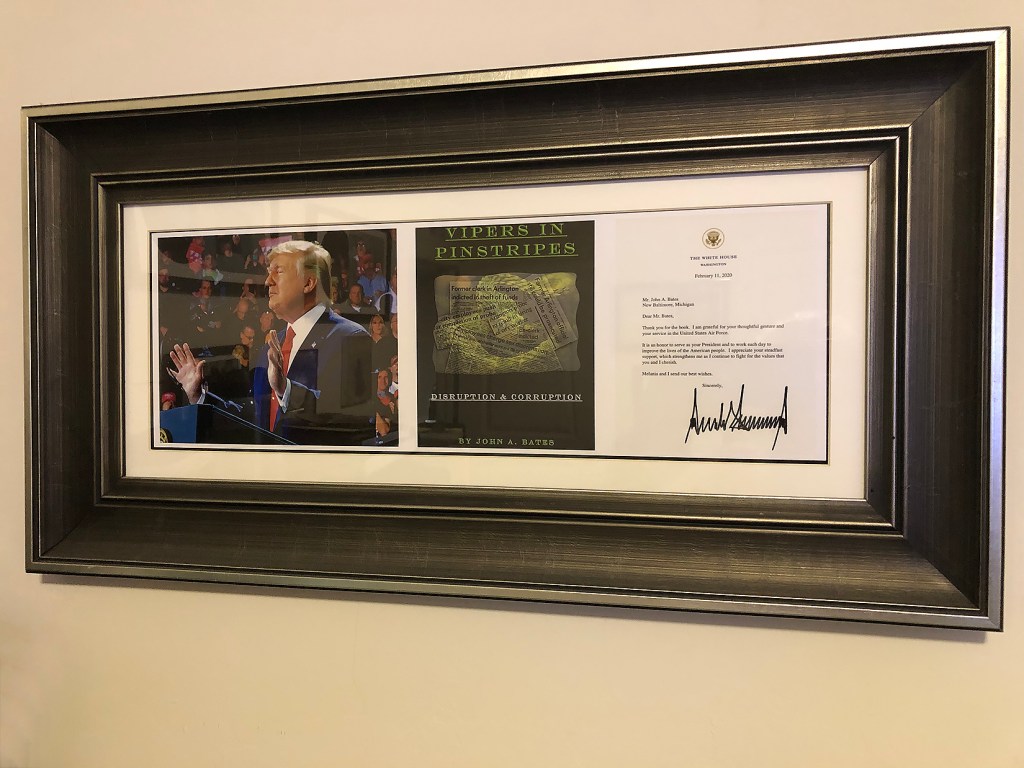
In this inaugural post of “Sprayed and Betrayed,” I will explore a potential path forward in our battle to get Okinawa recognized and listed by the Veterans Administration as a “presumptive location” as well as a more complete list of presumptive ailments that have plagued us for so long. First, a bit about my prior experience with this mindset. In September of 2019, I mailed an inscribed copy of my book Vipers In Pinstripes – Disruption and Corruption (link) to then-President Trump. In February 2020, I opened the mail to find a personal thank you letter from POTUS which now hangs on my home office wall.
Some of the best legal advice I received came from an unexpected source – that liberal law professor, Alan Dershowitz, when he actually answered his office phone back in the mid-80s. He advised me to get a copy of the Federal Rules of Civil Procedure. I promptly obtained a current copy and devoured the contents. After all, this was the “rule book” a team of attorneys would use against me in court, and I wanted to be prepared.
It mostly worked, but my case was eventually dismissed on a technicality. Even so, I had learned so much and extracted my pound of flesh – many misdeeds were corrected and guilty employees were exposed and disciplined.
That experience many years ago led me to contemplate the Supreme Court’s recent decision. By a vote of 6-3, the justices overruled their own landmark 1984 decision in Chevron v. Natural Resources Defense Council (link), which gave rise to the doctrine known as the Chevron doctrine.
In Chevron deference, Chief Justice Roberts explained that his opinion for the court is inconsistent with the Administrative Procedure Act (link). This federal law sets out the procedures that federal agencies must follow as well as instructions for courts to review actions by those agencies. The APA, Roberts noted, directs courts to “decide legal questions by applying their own judgment” and therefore “makes clear that agency interpretations of statutes — like agency interpretations of the Constitution — are not entitled to deference. Under the APA,” Roberts concluded, “it thus remains the responsibility of the court to decide whether the law means what the agency says.”
Roberts rejected any suggestion that agencies, rather than courts, are better suited to determine what ambiguities in federal law might mean… even when those ambiguities involve technical or scientific questions that fall within an agency’s area of expertise, Roberts emphasized, “Congress expects courts to handle technical statutory questions” – and courts also have the benefit of briefing from the parties and “friends of the court.”
According to the Federal Register, “Individuals and corporate entities may go into the courts to make a claim that they have been, or will be, damaged or adversely affected in some manner by a regulation. The reviewing court can consider whether a rule: is unconstitutional; goes beyond the agency’s legal authority; was made without following the notice‐and‐comment process required by the Administrative Procedure Act or other law; or was arbitrary, capricious, or an abuse of discretion. An agency head can also be sued for failing to act in a timely manner in certain cases.
Much like myself, your head is likely spinning from trying to absorb the legalese above, so I believe we should throw down some facts:
- The VA has acted arbitrarily for years by relying mainly on the advice and testimony of one man – Dr. Alvin Young. The exclusion of Okinawa (and other locations) from the Presumptive List of recognized locations where herbicides were stored and used for decades demonstrates a high-handed policy of health care and compensation denials and a demonstrable pattern of abuse of discretion by the Armed Forces Pest Management Board.
- As an aggrieved group, service members who were “boots on the ground” in Okinawa can absolutely go into the courts to make a claim that they have been, or will be, damaged or adversely affected in some concrete manner by a regulation or rule.
- A qualified attorney or (group of attorneys) can assemble the injured parties (veterans), file the lawsuit, and request reasonable relief in the form of administrative rule changes, compensation, and health care.
While such a case makes its way through the courts, Congress may also exercise its oversight in other ways, such as holding hearings and posing questions to agency heads, enacting new legislation, or imposing funding requirements.
Perhaps this is just a fantasy dancing around in my head, but I believe that taking some action is preferable to waiting for the Department of Veteran Affairs to do the “right thing” and stop treating veterans like petulant step-children.
What say you? Leave a comment!
 Sprayed and Betrayed